Nationwide "Explosive Diarrhea" Outbreak Tops 2,000 Cases
Cyclospora Parasite Spreads Across 18 U.S. States as Source Remains Elusive

Active Outbreak Alert: As of July 10, 2026, over 2,000 confirmed cyclosporiasis cases have been reported across 18 U.S. states, with more than 70 hospitalizations. Michigan is the epicenter with 1,500+ cases.
A severe gastrointestinal illness continues to spread rapidly across the United States this summer. Characterized most notably by "explosive" watery diarrhea, the outbreak is not caused by a typical stomach bug or virus, but by a microscopic parasite known as Cyclospora cayetanensis. [1] [2] As of July 10, 2026, cases have surged past 2,000 nationwide across 18 states, with Michigan bearing the brunt of the infections. [1] [3]
What Is Cyclosporiasis?
Cyclosporiasis is an intestinal infection caused by the Cyclospora parasite. When individuals consume food or water contaminated with feces containing the parasite, it infects the small intestine. [2] The most prominent and uncomfortable symptom is frequent, watery, and sometimes explosive bowel movements. [2]
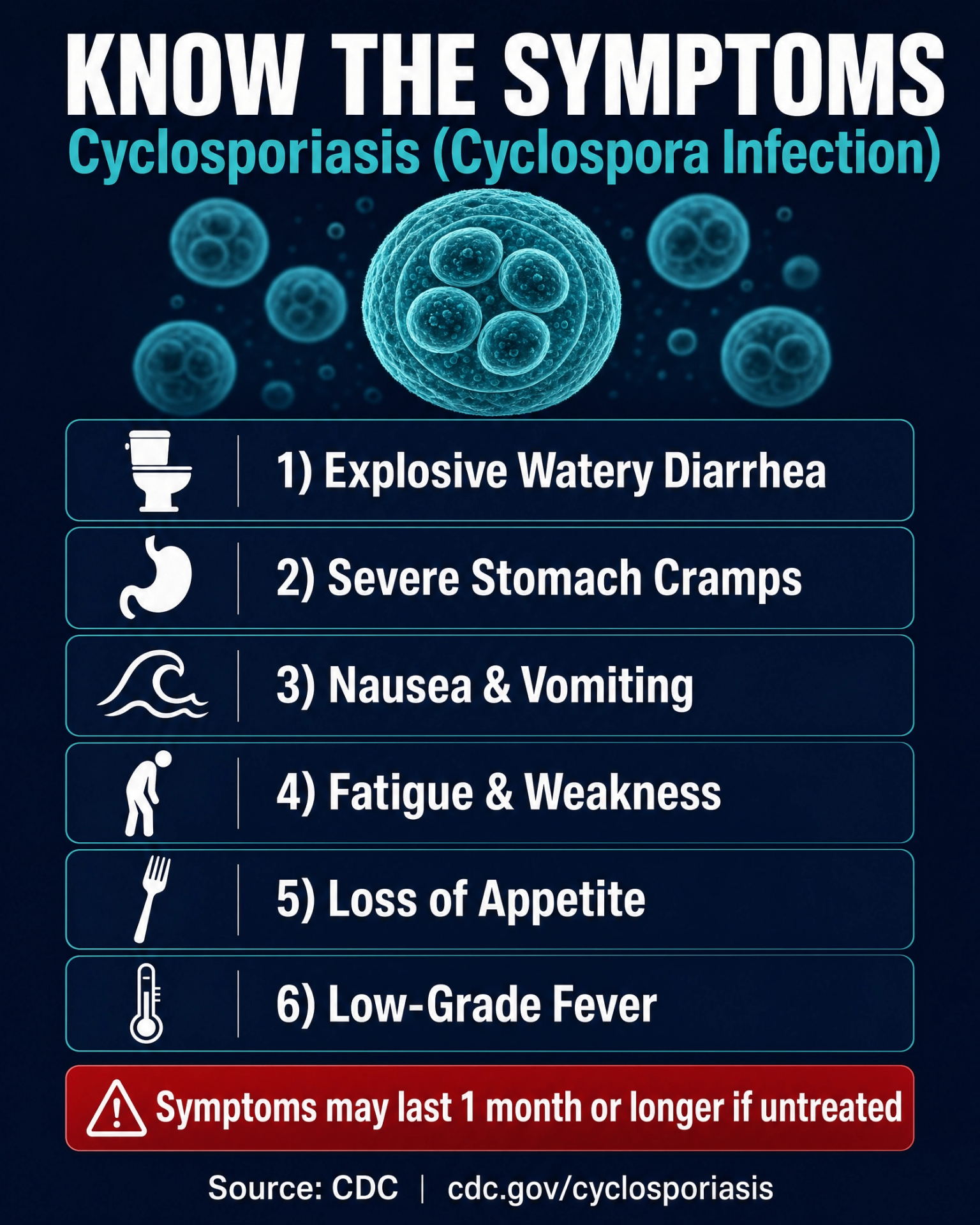
The six hallmark symptoms of a Cyclospora infection. Source: CDC.
The incubation period — the time between ingesting the parasite and feeling sick — is typically about one week, though it can range from two to 14 days. [2] [4] Because the parasite requires at least one to two weeks outside the body to become infectious, direct person-to-person transmission is highly unlikely. [2] If left untreated, symptoms can persist for over a month and may seemingly resolve only to return later. [2]
The July 2026 Outbreak: A Massive Surge
The summer months traditionally see an increase in Cyclospora cases, creating a "cyclosporiasis season" that the CDC tracks from May 1 to August 31. [2] [5] However, the summer of 2026 has seen an alarming spike that has caught public health officials off guard.
As of July 10, 2026, the outbreak has affected individuals across at least 18 states. [3] Michigan has been hit particularly hard, reporting more than 1,500 cases — a massive jump from the state's annual average of just 50 cases, making it the largest outbreak in the state's history. [1] [4]
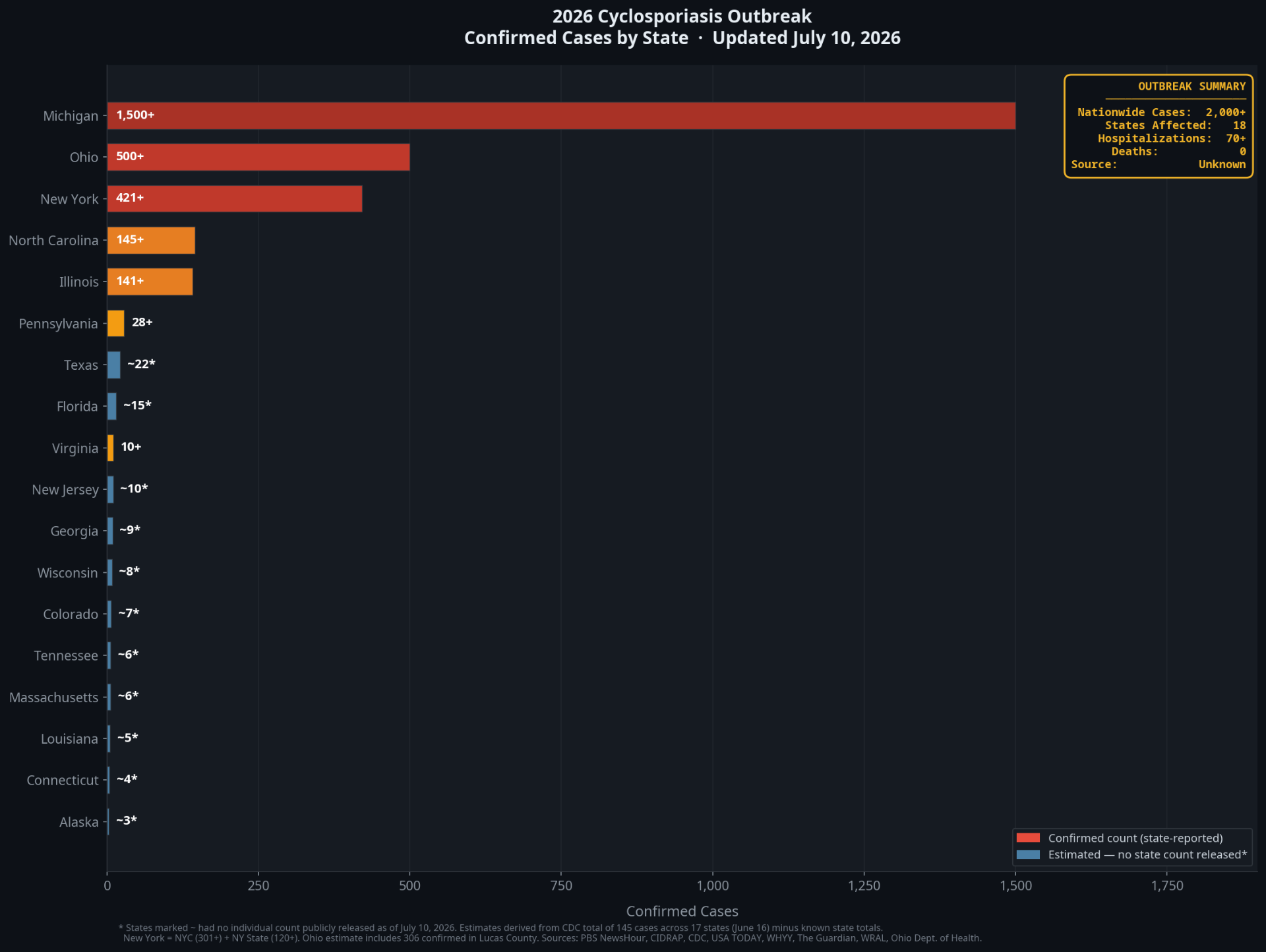
Confirmed cyclosporiasis cases by state, updated July 10, 2026.
| State | Confirmed Cases | Notable Detail |
|---|---|---|
| Michigan | 1,500+ | 44 hospitalizations; largest outbreak in state history |
| Ohio | 500+ | Over 300 cases in Lucas County alone |
| New York | 421+ | Includes international travel-related cases |
| North Carolina | 145+ | Majority in Wake County |
| Illinois | 141+ | 59 locally acquired |
| Pennsylvania | 28 | 14 cases in southeast PA |
| Nationwide Total | 2,000+ | 18 states affected |
The CDC noted that the true number of infections is likely much higher, as many people recover without seeking medical testing or care. [2] Furthermore, tracking the outbreak nationally has been complicated because the CDC made state reporting of Cyclospora optional in 2025. [1] [4]
The Challenge of Finding the Source
Despite the rising numbers, local and federal authorities have not yet identified a single, multistate source for the outbreak. [1] [2]
Investigating foodborne illnesses is notoriously difficult, particularly with Cyclospora. The long incubation period makes it hard for patients to recall exactly what they ate weeks prior. [6]
Furthermore, the parasite is historically linked to fresh produce — such as cilantro, parsley, basil, raspberries, and bagged salad mixes — which are often used as minor ingredients in meals and easily forgotten. [1] [6] By the time a common ingredient is identified among patients, the short shelf life of fresh produce means the contaminated product has usually already been discarded from the food supply. [6]
The Michigan Department of Health and Human Services recently issued guidance urging restaurants and commercial kitchens to implement enhanced washing procedures for lettuce, herbs, green onions, raspberries, and snow peas. [4]
Prevention and Treatment
While investigators continue to search for the source, health officials emphasize that prevention is the best defense.
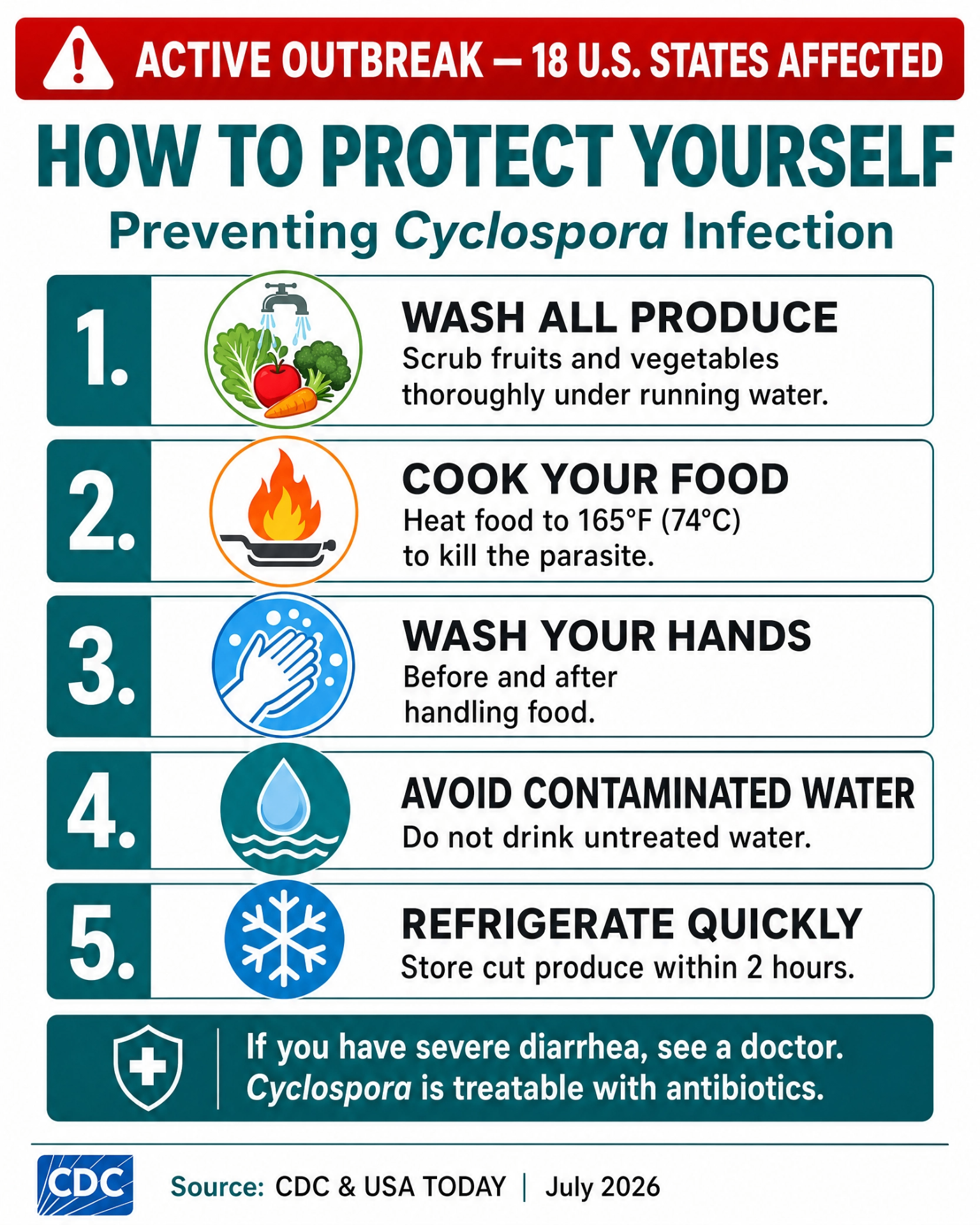
Five key prevention steps recommended by the CDC and USA Today, July 2026.
For those who do fall ill, a healthcare provider can diagnose cyclosporiasis through specific stool tests — it is important to note that standard stool tests do not detect Cyclospora, so patients must specifically request testing for it. [2] The infection is typically treated with a combination antibiotic, trimethoprim-sulfamethoxazole (commonly known as Bactrim or Septra). [2] Resting and staying well-hydrated are also crucial for recovery. [2]
Conclusion
The 2026 cyclosporiasis outbreak is a stark reminder of the vulnerability of the food supply chain and the importance of food safety practices. As the CDC and FDA continue their investigation, the public is urged to remain vigilant, wash produce thoroughly, and seek medical attention if severe gastrointestinal symptoms develop. Cases are expected to continue rising through August as the summer season progresses.
🎯 Key Takeaway
Wash all fresh produce thoroughly, cook food to safe temperatures, and if you develop persistent watery diarrhea lasting more than a few days, see a doctor and specifically request a Cyclospora stool test — the parasite is treatable with antibiotics.
References
- PBS NewsHour. (2026, July 10). What you need to know about the cyclosporiasis outbreak. pbs.org
- Centers for Disease Control and Prevention. (2026, July 1). Surveillance of Cyclosporiasis. cdc.gov
- USA TODAY. (2026, July 7). Cases of 'explosive' diarrhea illness top 1K. See states with the most. usatoday.com
- CIDRAP. (2026, July 9). US Cyclospora cases mount as CDC lags on tracking. cidrap.umn.edu
- The Guardian. (2026, July 7). Multiple US states see alarming increase in cases of parasitic illness that causes 'explosive' diarrhea. theguardian.com
- WRAL News. (2026, July 3). NC: 110 cases of stomach bug that can bring 'explosive diarrhea'. wral.com
- WHYY. (2026, July 10). An intestinal parasite is causing 'explosive' diarrhea in Pa. and N.J. whyy.org