The Ultimate Guide to Memorizing Muscle Origins and Insertions
Powerful Mnemonics, Color-Coding Techniques, and Study Tips for Kinesiology Students

Memorizing hundreds of muscle origins and insertions is one of the biggest challenges for any kinesiology student. It can feel like an impossible task, but with the right strategies, you can conquer this mountain of information and build a solid foundation for your career. This guide will provide you with the best memory tricks, study tips, and visual aids to make learning muscle anatomy easier and more effective.
Why Rote Memorization Fails
Simply reading and re-reading textbooks is not an effective way to learn muscle anatomy. The information is too dense and disconnected. To truly learn and retain this knowledge, you need to engage with the material in a more active and creative way. This involves using multiple learning styles—visual, auditory, and kinesthetic—to create stronger neural pathways.
1. The Power of Mnemonics
Mnemonics are memory devices that help you recall larger pieces of information with a simple phrase, acronym, or rhyme. They are incredibly effective for learning muscle groups.
Rotator Cuff: "SITS"
One of the most famous anatomy mnemonics is for the rotator cuff muscles. These four muscles stabilize the shoulder joint.
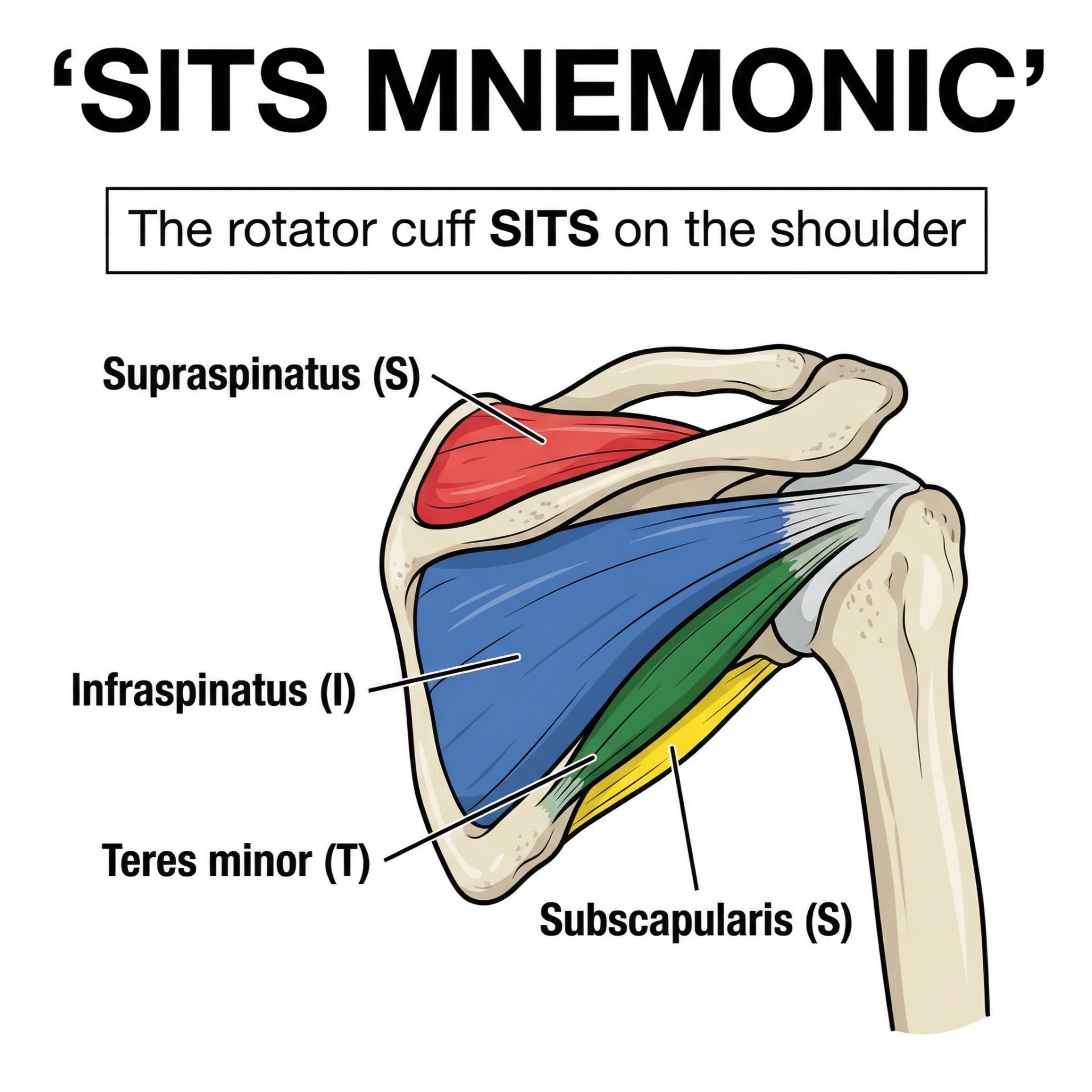
- Supraspinatus
- Infraspinatus
- Teres minor
- Subscapularis
💡 Memory Tip: Just remember that the rotator cuff SITS on the shoulder!
Lateral Rotators of the Hip: "Piece Goods Often Go On Quilts"
This mnemonic helps you remember the six lateral rotators of the hip, from superior to inferior:
- Piriformis
- Gemellus superior
- Obturator internus
- Gemellus inferior
- Obturator externus
- Quadratus femoris
2. Color-Coding for Visual Learners
If you are a visual learner, color-coding is one of the most powerful techniques you can use. Assign a specific color to origins, insertions, and actions. This turns a black-and-white page of text into a vibrant, organized map.
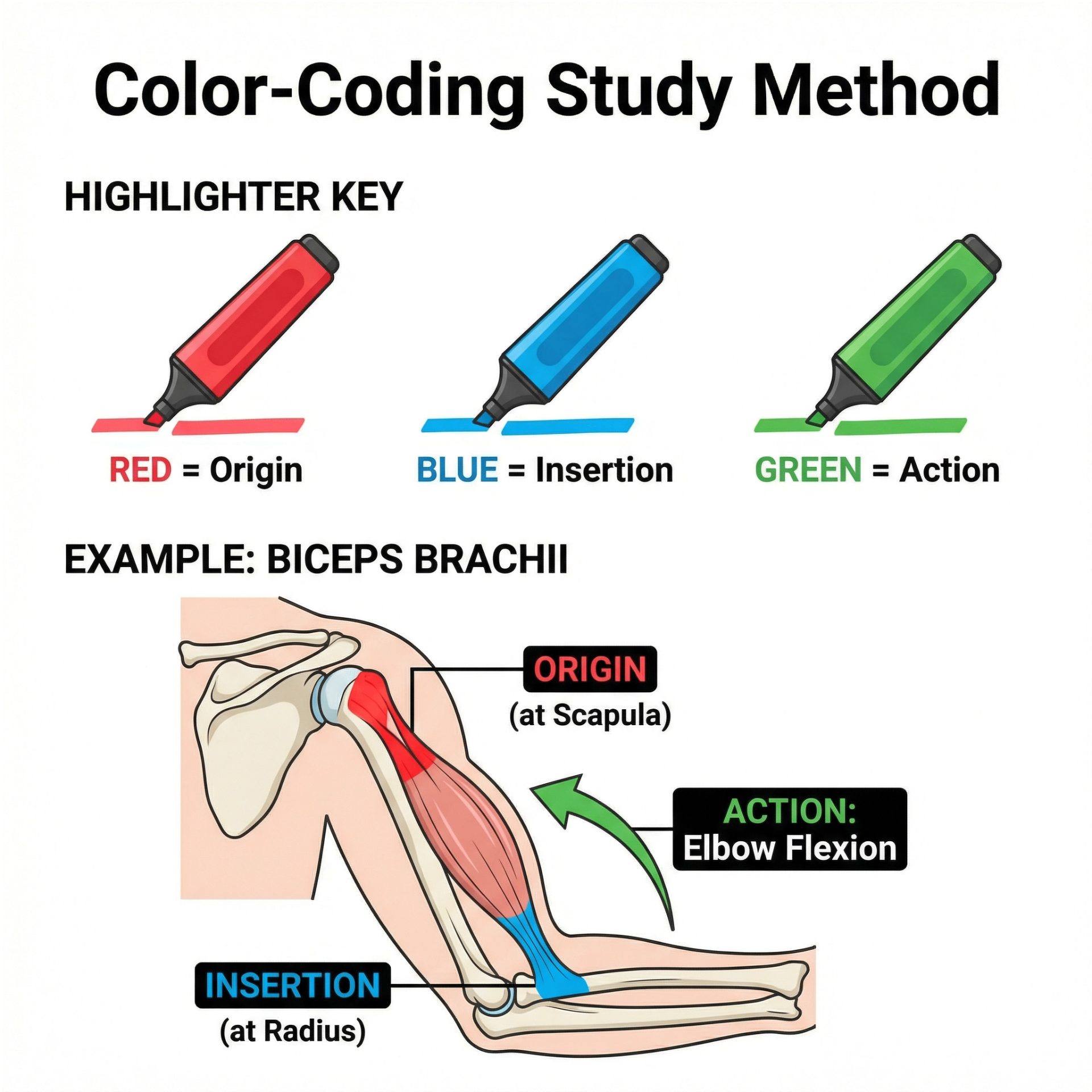
How to do it:
- 1.Choose your colors: For example, RED for origins, BLUE for insertions, and GREEN for actions.
- 2.Highlight your notes: As you study each muscle, highlight the origin, insertion, and action in your chosen colors.
- 3.Draw your own diagrams: Get an anatomy coloring book or print out blank muscle charts and color in the attachment sites yourself. This combination of visual and kinesthetic learning is incredibly effective.
3. Get Hands-On: Tactile Learning
Your own body is the best study tool you have! Feeling the muscles contract and move can create a powerful mind-body connection.
- 🖐️Palpate yourself:
As you learn a muscle, find it on your own body. Feel where it starts and ends. Contract the muscle to feel its action.
- 🦴Use a skeleton model:
If you have access to one, use a skeleton model to trace the origin and insertion points with your fingers.
- 💪Act it out:
Perform the action of the muscle. If you're learning the biceps brachii, do a bicep curl. This helps you understand the function in a real-world context.
4. Chunking: Don't Learn Everything at Once
Trying to memorize all 600+ muscles at once is a recipe for burnout. Instead, break the body down into smaller, manageable chunks.
📅 Example Study Plan:
- Week 1: Shoulder and Upper Arm (e.g., deltoid, biceps, triceps, rotator cuff)
- Week 2: Forearm and Hand
- Week 3: Hip and Thigh (e.g., glutes, quads, hamstrings)
- Week 4: Lower Leg and Foot
Focus on mastering one region before moving to the next. This builds confidence and makes the task less daunting.
5. Study Tips from Successful Students
We asked successful kinesiology graduates for their best tips. Here's what they said:
"Flashcards were a lifesaver. I made my own with a picture of the muscle on one side and the O/I/A on the back. I carried them everywhere."
— Sarah, DPT
"Teaching my classmates was the best way for me to learn. If you can explain it to someone else, you truly understand it."
— Mike, ATC
"Don't just memorize the words. Understand the why. Why does the muscle attach there? How does that attachment create the movement?"
— Jessica, CSCS
Summary Table of Study Techniques
| Technique | Learning Style | How it Works |
|---|---|---|
| Mnemonics | Auditory | Creates memorable phrases to recall muscle groups. |
| Color-Coding | Visual | Organizes information visually with colors. |
| Tactile Learning | Kinesthetic | Uses touch and movement to create a mind-body connection. |
| Chunking | Organizational | Breaks down large amounts of information into smaller parts. |
| Teaching Others | Auditory/Kinesthetic | Reinforces your own knowledge by explaining it. |
By combining these techniques, you can create a study system that works for you and finally conquer muscle origins and insertions. Happy studying! 🎓
References
- [1] Geeky Medics. (2022). Anatomy Mnemonics. geekymedics.com
- [2] Kenhub. (2024). How to learn anatomy with mnemonics. kenhub.com
- [3] MBLEX Guide. Anatomy Memorization Tricks. mblexguide.com