A Flesh-Eating Parasite Has Returned to the US — And the Government Is Panicking
New World Screwworm Confirmed in 32 U.S. Locations Across Texas and New Mexico
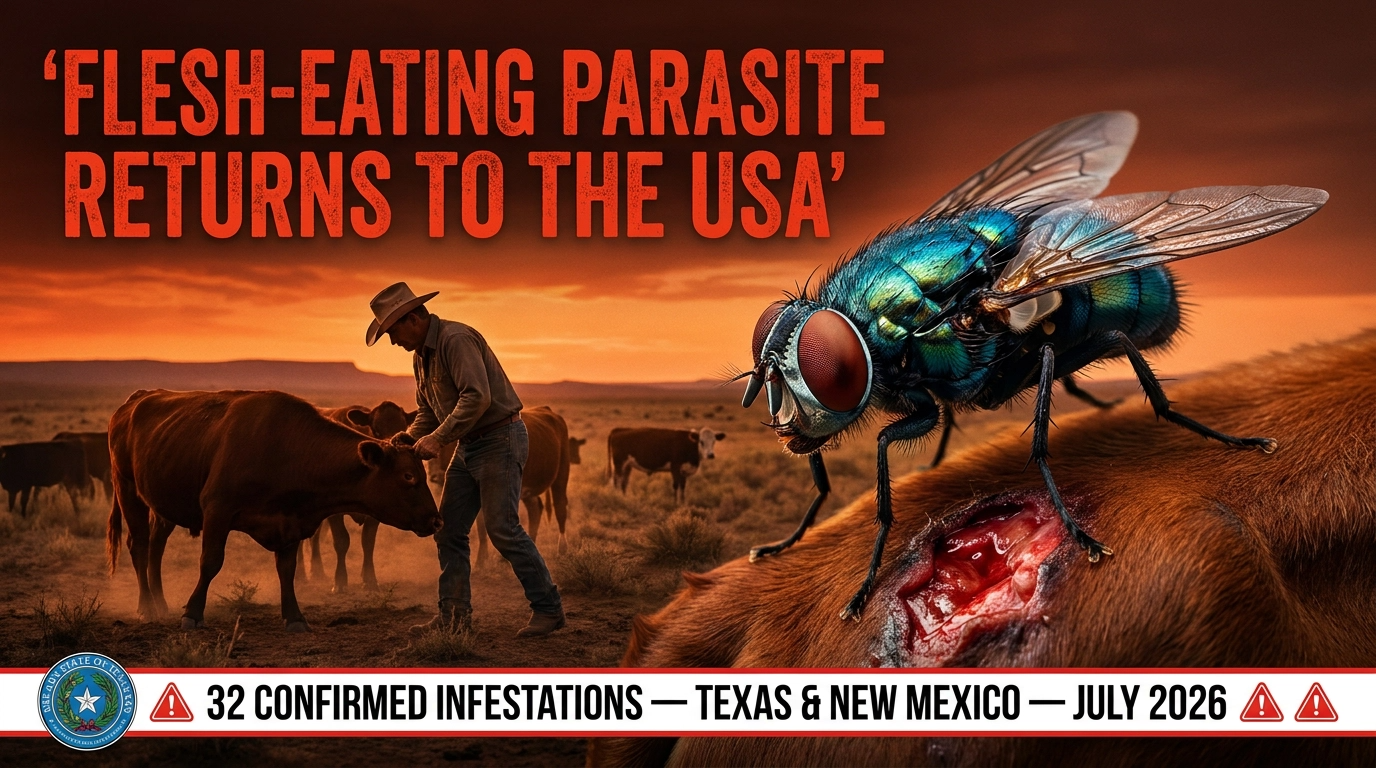
Active Outbreak Alert: The USDA has confirmed 32 New World screwworm infestations — 31 in Texas and 1 in New Mexico — the first U.S. cases in over 50 years. Ranchers, pet owners, and health officials are on high alert.
For the first time in over 50 years, one of the most horrifying pests in the animal kingdom has returned to the United States. The New World screwworm (Cochliomyia hominivorax), a parasitic fly whose larvae literally eat the living flesh of warm-blooded animals, has crossed the border from Mexico. [1] As of July 2026, the U.S. Department of Agriculture (USDA) has confirmed 32 infestations — 31 in Texas and one in New Mexico — triggering a full-scale emergency response from federal and state agricultural officials. [1]
The return of the screwworm is not just an agricultural crisis; it is a nightmare scenario for livestock, wildlife, and even pets. While human infestations are rare, the gruesome nature of the parasite and its potential to cause billions of dollars in economic damage has placed the entire southwestern United States on high alert. [2]
The Nightmare Lifecycle
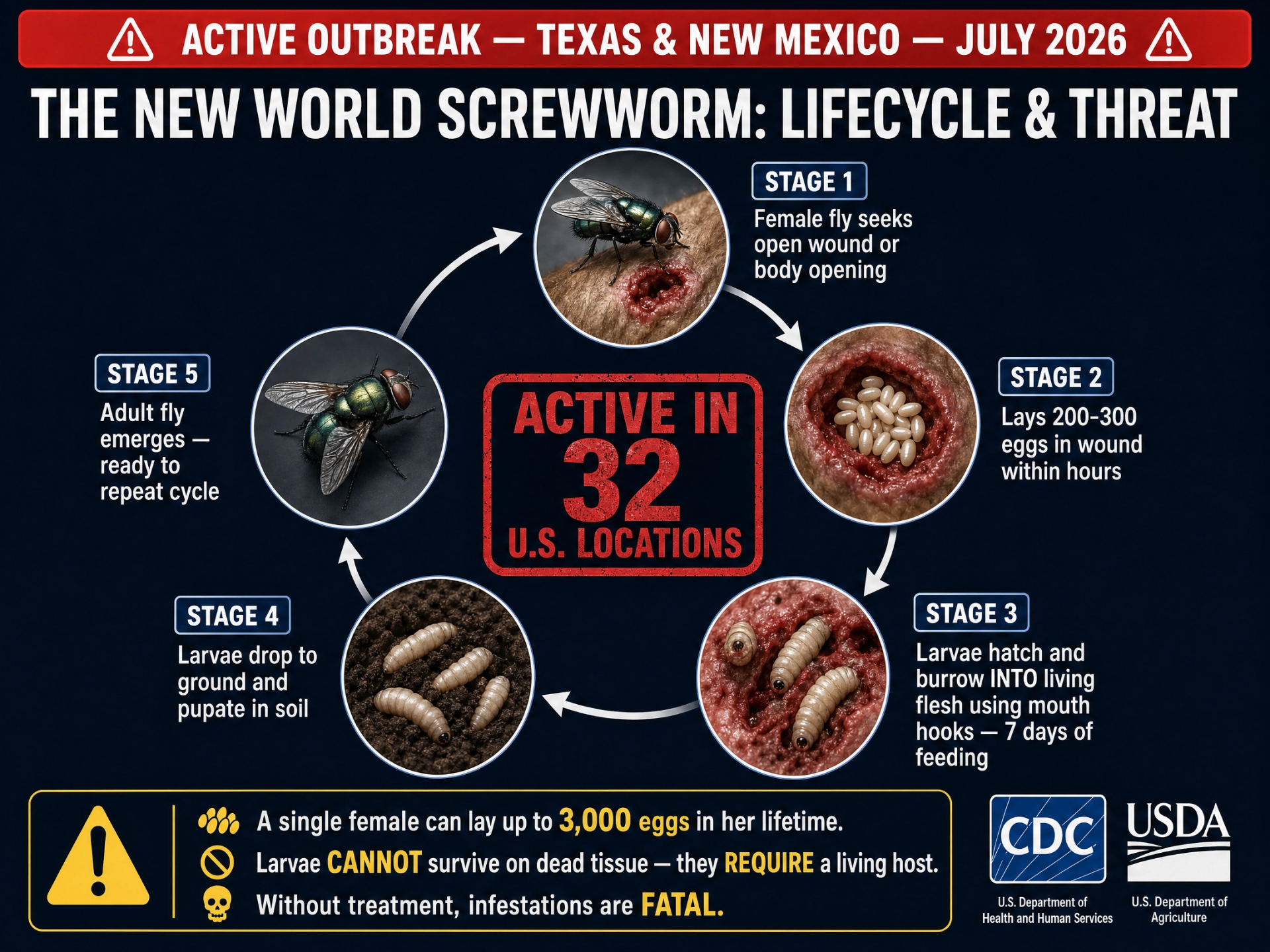
The five-stage lifecycle of the New World screwworm. Source: CDC & USDA.
Unlike common maggots, which feed on dead or decaying tissue, the New World screwworm requires living tissue to survive. [3] The terrifying lifecycle begins when a female fly seeks out an open wound or mucous membrane — such as the eyes, ears, nose, or mouth — on a live, warm-blooded animal. [4] Wounds as small as a tick bite are enough to attract a female fly, which can lay up to 300 eggs at a time. [4]
Within 12 to 24 hours, the eggs hatch into parasitic maggots. These larvae immediately burrow deeper into the host's flesh, using sharp mouth hooks to tear into the living tissue. [2] [4] As they feed, the wound enlarges, often attracting more female flies to lay additional eggs. [1]
"As the larvae burrow deeper into tissue, wounds become larger and often infected. Without treatment, infestations can be fatal." — Houston Public Media [1]
After feeding for about seven days, the larvae drop to the ground, burrow into the soil, and emerge as adult flies, ready to repeat the cycle. [4] Animals infested with screwworm suffer immense pain and may exhibit symptoms such as bloody or foul-smelling drainage, visible larvae moving inside the wound, and extreme restlessness. [1] If left untreated, the infestation can cause death from shock or secondary infections as the larvae migrate into vital organs. [3]
The Economic and Agricultural Threat
The United States eradicated the New World screwworm in the 1960s using a groundbreaking method known as the sterile insect technique. [1] Scientists bred and released millions of sterile male flies; because females only mate once, breeding with a sterile male resulted in unfertilized eggs, eventually collapsing the wild population. [1]
However, the parasite has steadily moved northward from South America since 2023, passing through Central America and Mexico before finally breaching the U.S. border in June 2026. [4] The Dallas Federal Reserve estimates that a widespread screwworm outbreak could cause billions of dollars in economic damage in the southwestern U.S. alone. [2]
Texas, with its massive livestock industry and abundant wildlife populations (particularly white-tailed deer), is uniquely vulnerable. [1] The parasite threatens to raise the price of beef at a time when consumers are already facing record-high costs. [2]
| Animals Most at Risk | Description of Threat |
|---|---|
| Cattle & Livestock | Highly vulnerable to infestations after branding, calving, or minor injuries. A widespread outbreak could devastate the $113 billion U.S. cattle industry. [3] |
| Wildlife (e.g., Deer) | Extremely susceptible because there is no practical way to treat wild animals. Infestations in deer populations can spread rapidly. [1] |
| Pets (Dogs & Cats) | Two confirmed cases in dogs have already been reported in Texas and New Mexico. Vets urge owners to check pets regularly and use prescription flea/tick medications that kill larvae. [3] |
| Humans | Rare, but possible. Any open wound, scratch, or insect bite can attract the fly in affected areas. [4] |
Is the Food Supply Safe?
Despite the gruesome nature of the parasite, public health leaders and agricultural experts emphasize that the New World screwworm is not a direct threat to the nation's food safety. [2]
Screwworm larvae cannot survive on nonliving material; if a host animal dies, the larvae typically die with it. [2] Furthermore, the U.S. meat inspection system is designed to catch sick animals long before they enter the food supply.
"It's a threat to food, inasmuch as it's a threat to food prices, but it's not a threat from the perspective of food quality or the food that you'll be consuming." — Maximillian Seunik, Executive Director, Screwworm Free Future [2]
Even if an infested animal were somehow slaughtered, the larvae would be highly visible, and the meat would be condemned during post-mortem inspections. [2]
How to Protect Yourself and Your Pets
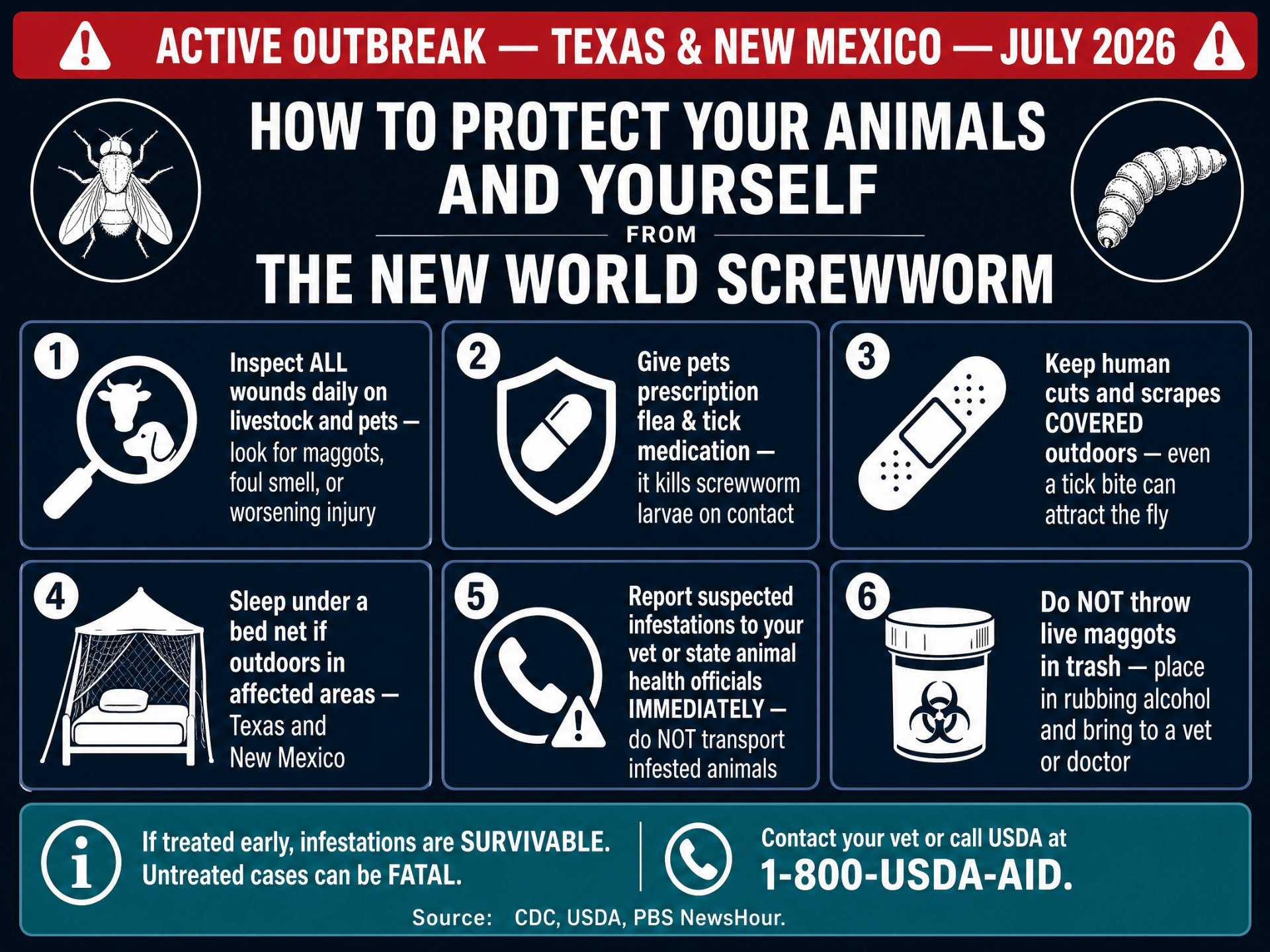
Six essential steps to protect your animals and yourself. Source: CDC, USDA, PBS NewsHour.
While human cases are exceedingly rare, the CDC warns that individuals spending time outdoors in affected areas should take precautions. [4] The USDA is not waiting for the winter freeze to kill off the tropical flies. The agency has already invested $21 million in a sterile fly breeding facility in southern Mexico and plans to open a $750 million facility in Texas next year to launch a massive sterile-fly release campaign. [3]
Until then, ranchers, pet owners, and health officials remain on high alert as they battle the return of a nightmare pest that was supposed to be gone forever.
🎯 Key Takeaway
Inspect all wounds on livestock and pets daily, keep human cuts and scrapes covered outdoors, and report suspected infestations immediately to your vet or the USDA at 1-800-USDA-AID. Early treatment is survivable — untreated screwworm infestations can be fatal.
References
- Houston Public Media. (2026, July 7). 32 confirmed New World screwworm infestations: Texas tracker and what you need to know. houstonpublicmedia.org
- CNN. (2026, July 5). New World screwworm is disgusting. How could it not be a food safety issue? cnn.com
- PBS NewsHour. (2026). How to protect your pets from the New World screwworm fly. pbs.org
- Centers for Disease Control and Prevention. About New World Screwworm. cdc.gov