The Sprinting Paradox
How a 17-Year-Old Phenom Is Rewriting the Rules of Speed

In the world of elite athletics, speed has long been pursued through a rigid lens of perfection. Coaches and scientists have spent decades chasing a universal blueprint for the "perfect" sprinting form—a single, idealized model that every athlete should strive to emulate. But what if that blueprint never existed? A recent wave of groundbreaking research, embodied by the explosive arrival of a 17-year-old Australian phenom, is suggesting just that.
This is the story of how a new scientific paradigm and a once-in-a-generation talent are forcing the world of kinesiology to rethink the very nature of speed.
Rising sprint star Gout Gout is challenging conventional assumptions about what makes athletes fast.
His name is Gout Gout, and he is a paradox in motion. At just 17, he has shattered long-standing national records and is posting times that put him in the company of legends like Usain Bolt and Michael Johnson. Yet, he doesn't fit the mold. He lacks the brawny, muscular physique of past champions. His race profile is unconventional. And his technique—a mesmerizing blend of extraordinary stride length and seemingly effortless power—is uniquely his own.
Gout's success is the living embodiment of a new theory sending ripples through the sports science community: the idea that peak performance is not about conforming to a single ideal, but about discovering an individual's optimal movement solution.
The Myth of the "Perfect Form"
For decades, the prevailing wisdom in sprint coaching has been prescriptive. It was believed that a single, optimal running technique existed, and the coach's role was to drill this pattern into their athletes until it became second nature. This approach, rooted in a classical, mechanical view of the body, treated athletes like machines to be standardized. Variations from the "perfect" form were seen as errors to be corrected, and inconsistency was a flaw to be eliminated through relentless repetition.
This traditional model, however, struggled to explain the diversity of techniques seen among the world's best. Why did Usain Bolt, with his unusually long stride, dominate the sport? How could Michael Johnson, with his upright posture and short, choppy steps, be so fast? The one-size-fits-all model was showing its cracks.
A New Paradigm: The Dynamical Systems Perspective
Enter a team of international researchers led by Dr. Dylan Hicks of Flinders University. Their work, published in the journal Sports Medicine, proposes a radical new framework for understanding sprint performance: the Dynamical Systems Perspective. This theory argues that sprinting is not a fixed, mechanical process, but an emergent property that arises from a complex interplay of factors unique to each athlete.
"For decades, sprint coaching has often been based on the belief that all athletes should move in one prescribed way. But our research shows that sprinting is far more complex. The best athletes in the world don't all run the same. What they share is not one technique but the ability to organize their bodies efficiently under pressure—and that looks different for every sprinter."
According to this model, an athlete's optimal running form is a unique solution that emerges from the interaction of:
Individual Constraints
Body structure, limb length, muscle fiber type, and strength profile.
Environmental Constraints
The running surface, weather conditions, and even the type of footwear.
Task Constraints
The distance of the race, the need to navigate a curve, or the pressure of competition.
This perspective celebrates individuality. It suggests that movement variability—those small, seemingly random fluctuations in an athlete's form—is not a sign of error, but a vital component of learning and adaptation. It is the body's way of exploring and discovering its most efficient movement patterns.
Case Study: The Biomechanics of Gout Gout
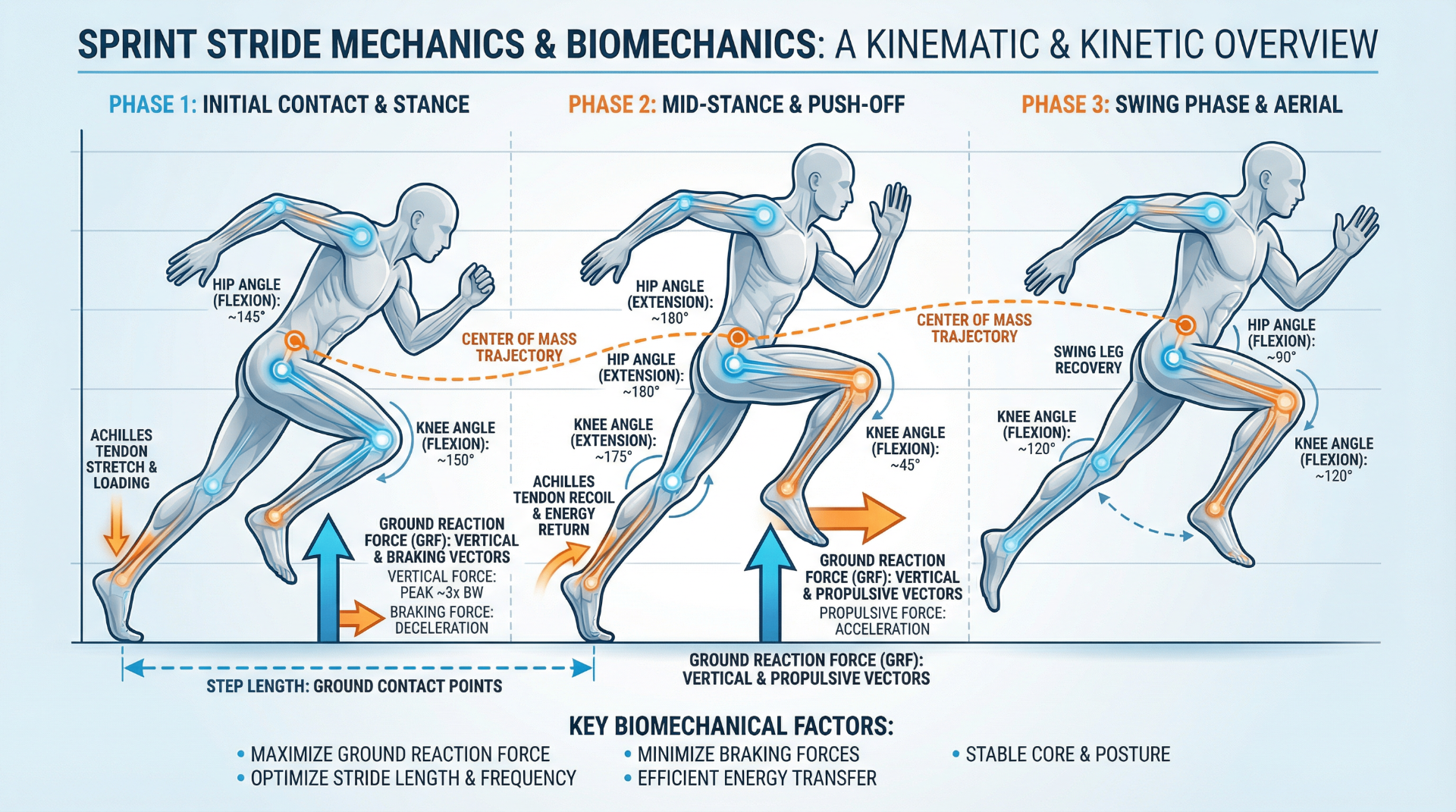
Gout Gout is the perfect case study for this new paradigm. His performance defies traditional expectations and showcases a unique blend of biomechanical advantages.
| Biomechanical Factor | Gout Gout's Profile | Comparison to Elite Sprinters | Kinesiological Implication |
|---|---|---|---|
| Speed Endurance | Can maintain top speed for longer, with a devastating finish. | His final 100m in a 200m race (9.31s) is comparable to Bolt (9.27s) and Johnson (9.20s). | Exceptional neuromuscular efficiency and fatigue resistance. |
| Step Length | Averages an extraordinary 2.60 meters. | Significantly longer than Bolt's 2.45m average during his 100m world record. | Covers more ground per stride—a huge competitive advantage. |
| Step Frequency | Averages a lower 4.15 steps per second (Hz). | Lower than Bolt's 4.47Hz, showcasing a trade-off with stride length. | Supports the theory that athletes optimize either step length or frequency. |
| Coordination | Described as having "springs in his spikes." | Utilizes elastic energy from his Achilles tendon as a power amplifier. | Highly efficient use of the stretch-shortening cycle for propulsion. |
"Gout Gout shows how individual characteristics can shape world-class speed in different ways. His longer limbs, elastic qualities, and remarkable coordination blend to produce the step patterns we see when he's at full flight."
He is not fast despite his unique style; he is fast because of it.
The Future of Sprint Coaching
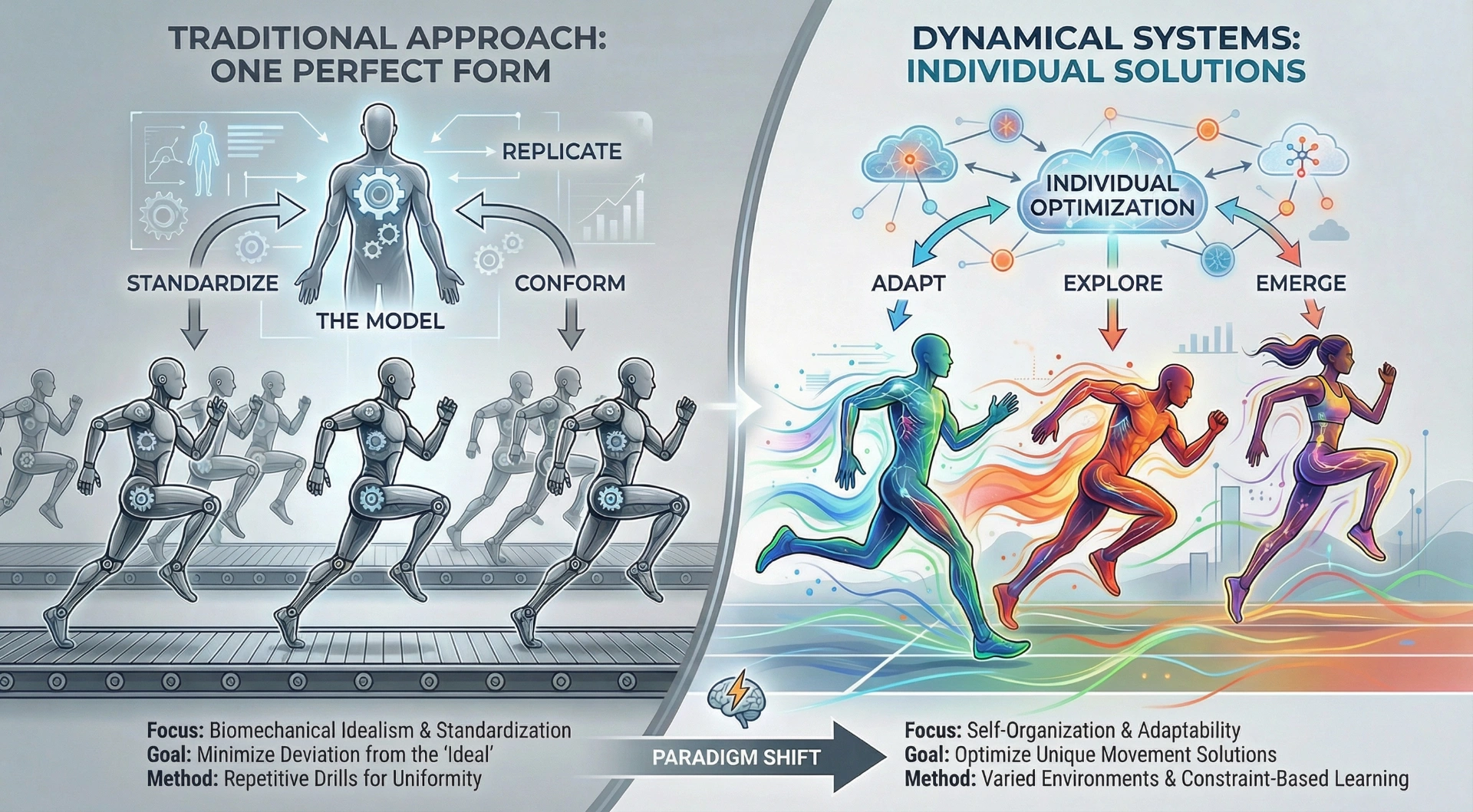
The implications of this research are profound. It calls for a fundamental shift in how we coach and develop sprinters. The focus moves away from enforcing a rigid template and towards creating a learning environment where athletes can discover their own optimal movement solutions.
This new approach involves:
Embracing Individuality
Recognizing that every athlete has a unique physical and mechanical profile.
Encouraging Exploration
Using varied drills and modified constraints—like changing hurdle spacing or running surfaces—to encourage athletes to problem-solve.
Guiding, Not Dictating
Acting as a facilitator who helps athletes understand the principles of efficient movement, rather than demanding conformity.
This paradigm shift may be the key to unlocking the next level of human performance. By abandoning the search for a mythical "perfect form" and instead focusing on the individual, we can create more resilient, adaptable, and ultimately, faster athletes. The story of Gout Gout is not just the story of one remarkable talent; it is a glimpse into the future of sprinting—a future where individuality is not just accepted, but celebrated as the true source of speed.
References
- Hicks, D., & van den Tillaar, R. (2025, March 30). Step length, a devastating finish and 'springs in his spikes': the science behind Gout Gout's speed. The Conversation. Link
- Flinders University. (2026, February 18). New Research Challenges Long-Held Beliefs About What Makes the World's Fastest Sprinters So Quick. SciTechDaily. Link
- Hicks, D. S., McMillan, S., Schöllhorn, W., & van den Tillaar, R. (2026). Sprint Running Coordination: A Dynamical Systems Perspective. Sports Medicine. DOI Link
- Flinders University. (2026, February 17). Sprinting science that rewrites the rulebook. Flinders University News. Link