Center of Gravity
The key to balance and stability — understand how the center of gravity governs every movement we make.
Introduction
In the study of human movement, few concepts are as fundamental as the center of gravity (COG). It is the invisible point that governs our balance, dictates our stability, and influences every motion we make, from the simple act of standing to the complex acrobatics of a gymnast.
Understanding the COG is not just an academic exercise; it is the key to unlocking better performance, preventing injuries, and designing effective rehabilitation programs.
Watch: Center of Gravity Explained
Defining the Center of Gravity
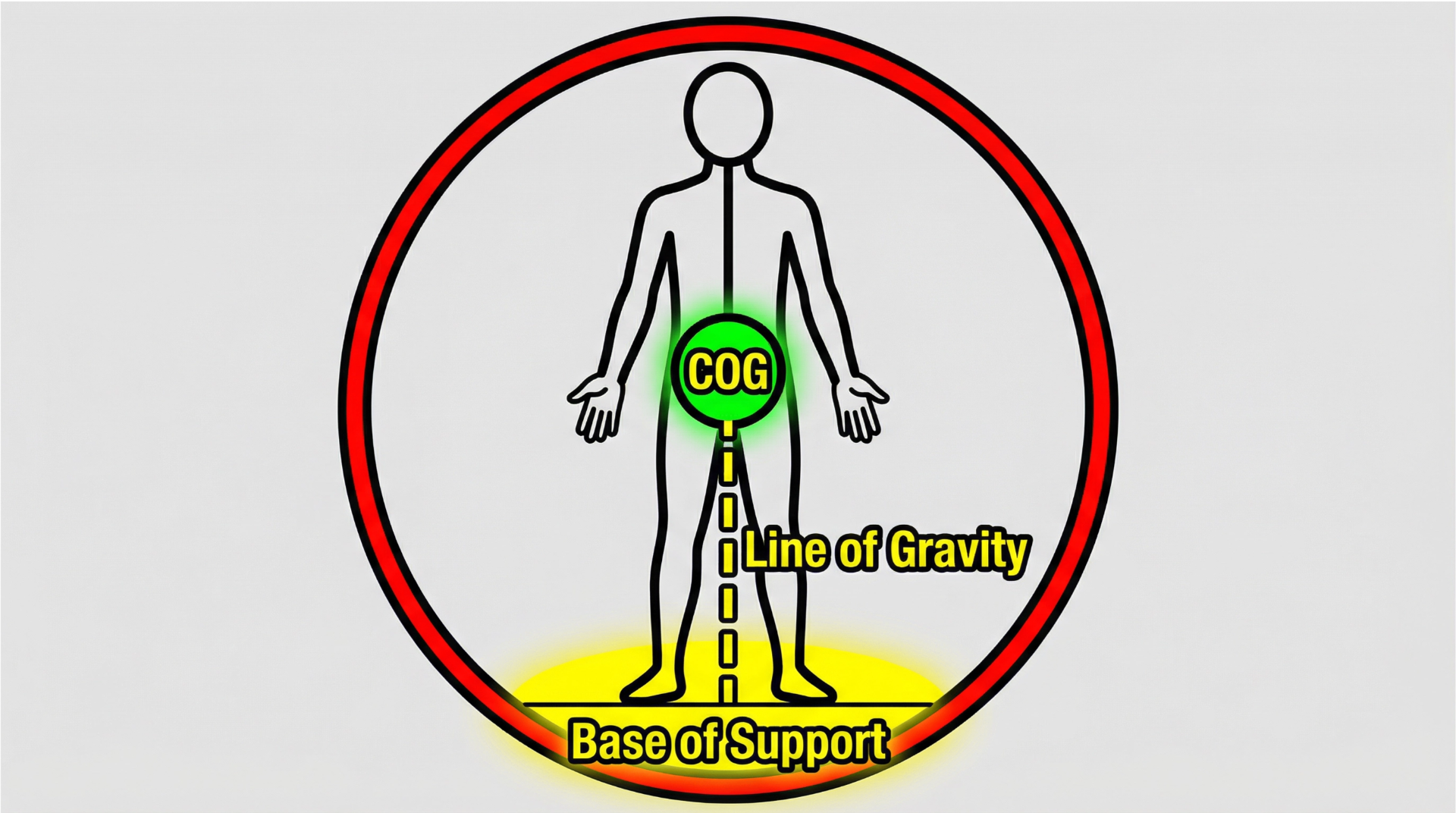
The center of gravity is a hypothetical point around which the force of gravity appears to act. It is the point at which the combined mass of the body is concentrated. Since it is a hypothetical point, the COG does not have to lie within the physical boundaries of an object or person.
To understand stability, we must also define two related terms:
📍 Line of Gravity: An imaginary vertical line passing from the center of gravity down to the ground.
🦶 Base of Support (BOS): The area beneath an object or person that includes every point of contact with the supporting surface — feet, hands, crutches, or even a chair.
Location in the Human Body
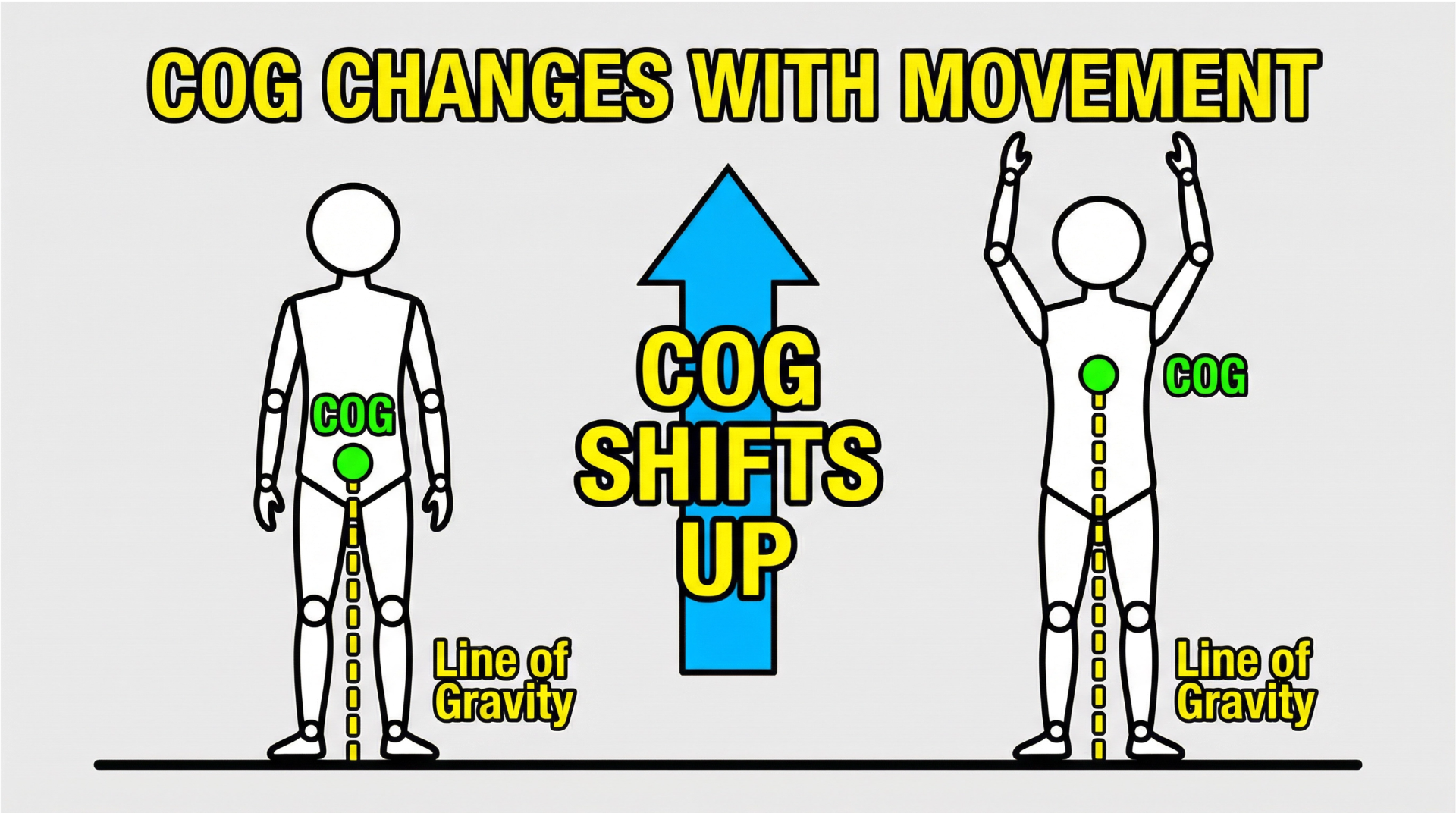
In the standard anatomical position, the COG in a human adult is located approximately anterior to the second sacral vertebra, at the center of the pelvis. However, this is not a fixed point — the precise location is dynamic and constantly shifts with every movement.
| Factor | Description |
|---|---|
| Body Composition | More upper body muscle mass = slightly higher COG |
| Posture | Slouching or leaning shifts the COG |
| Movement | Every limb movement causes the COG to shift |
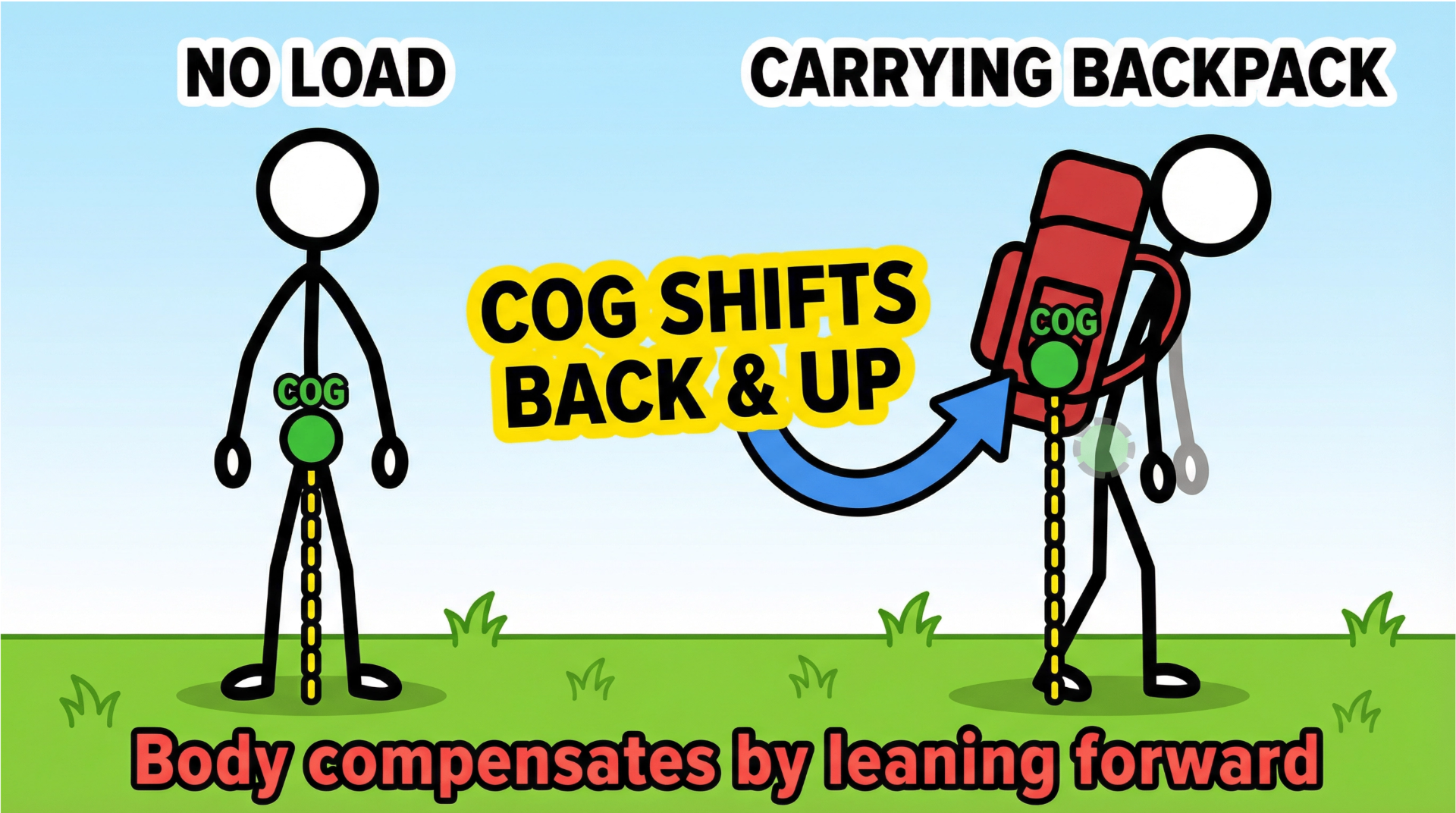
| External Loads | Carrying objects shifts the COG toward the load |
| Age and Gender | COG is generally lower in children and women |
Center of Gravity and Stability
The relationship between the center of gravity, line of gravity, and base of support is the cornerstone of balance. A person is stable when the line of gravity falls within the base of support. When it falls outside, the person becomes unstable and must take corrective action.
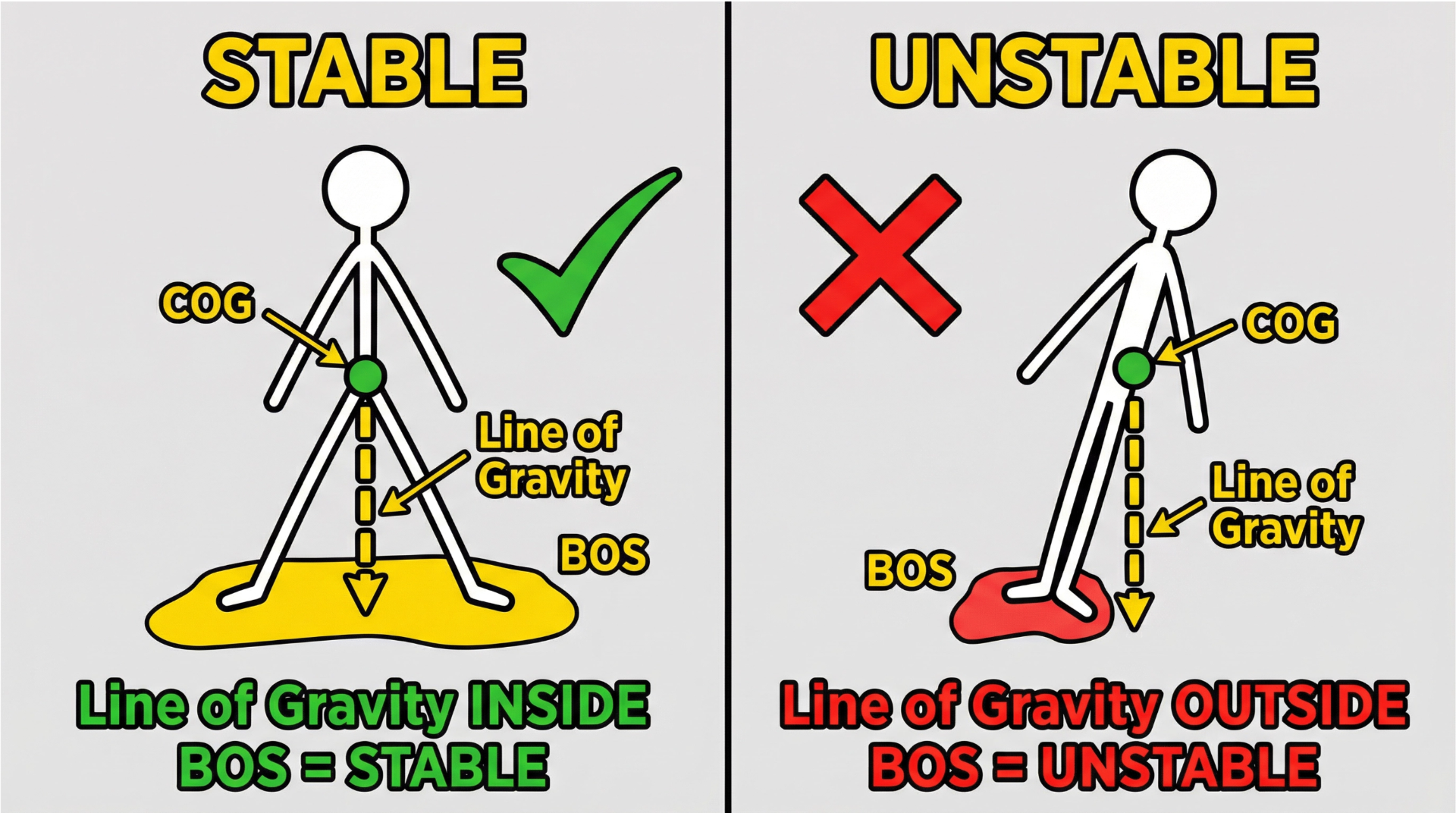
⬇️ Principle 1: A lower center of gravity increases stability. The lower the COG, the more effort is required to push it outside the base of support.
↔️ Principle 2: A larger base of support increases stability. A wider stance means the line of gravity must travel farther before falling outside the BOS.
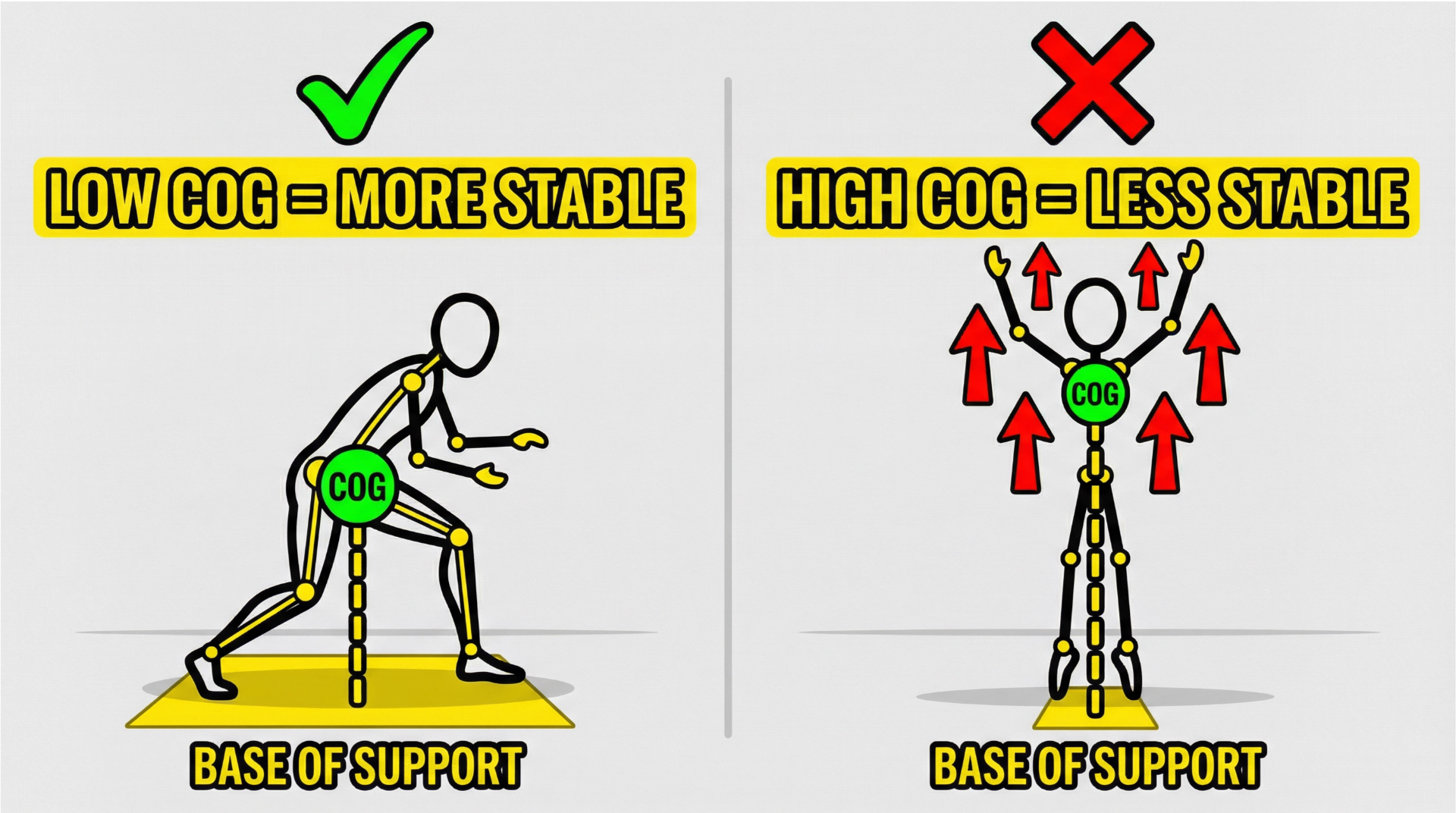
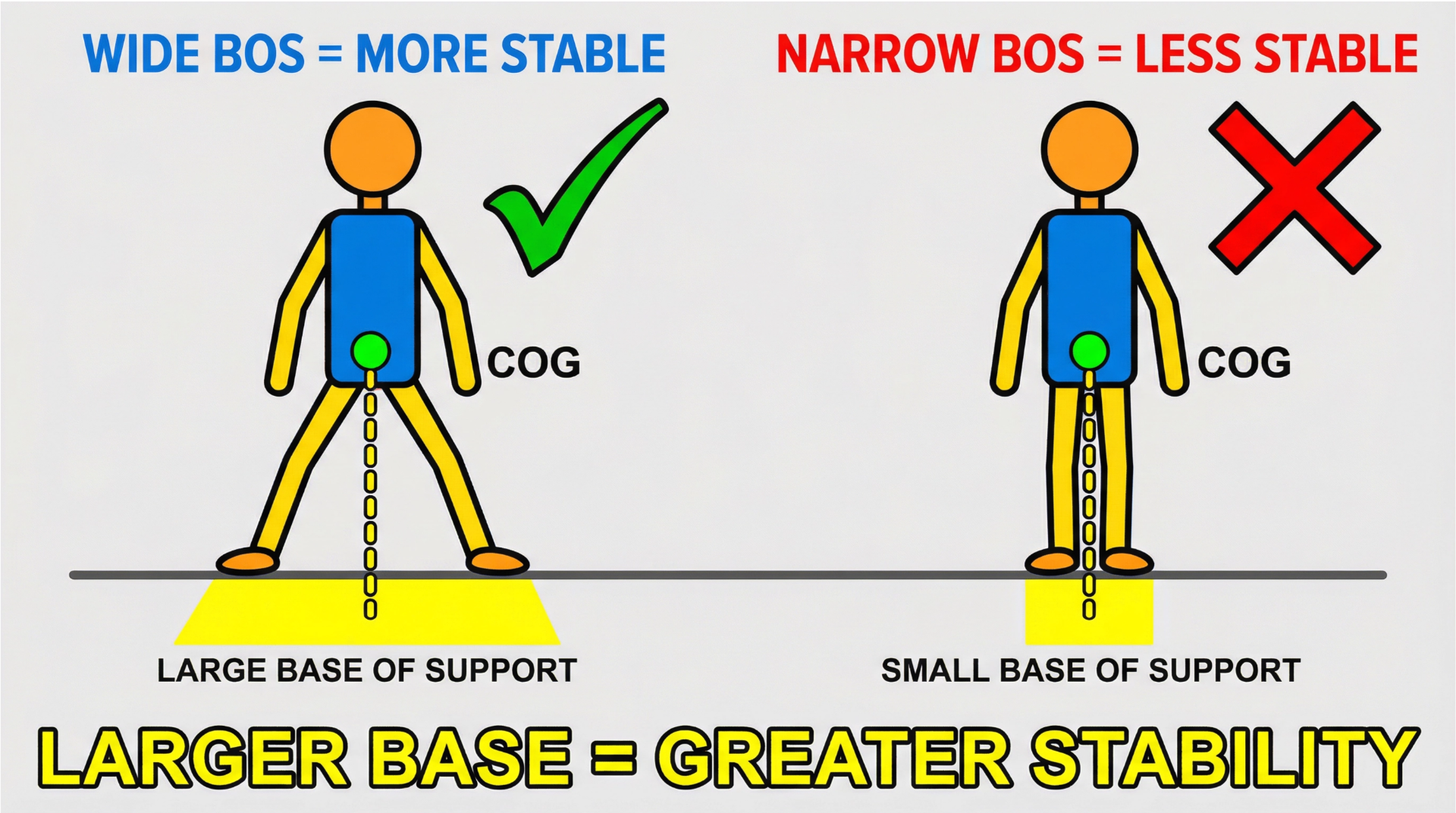
💡 That's why wrestlers and defensive linemen crouch low with a wide stance — lower COG + wider BOS = maximum stability!
Clinical and Practical Applications
🏥 Rehabilitation
Physical therapists design exercises that improve balance and reduce fall risk in elderly patients or those recovering from injury.
🏆 Sports Performance
Athletes manipulate the COG to optimize performance. A high jumper arches their back so the COG passes under the bar.
🏗️ Ergonomics
Understanding COG and stability is crucial for designing safe workspaces and lifting techniques to prevent workplace injuries.
🦿 Prosthetics
Prosthetic limb design must account for the user's center of gravity to ensure a stable and natural gait.
Conclusion
The center of gravity is a fundamental concept in biomechanics that governs our ability to balance and move effectively. By understanding the interplay between the center of gravity, line of gravity, and base of support, we can better analyze human movement, improve performance, and enhance safety.
Whether you are an athlete, a clinician, or simply someone interested in the mechanics of the human body, a firm grasp of these principles is essential for understanding how we stay upright and move through the world.
References
- Physiopedia. Centre of Gravity. physio-pedia.com
- Open Oregon Educational Resources. Body Physics 2.0: Body Stability. openoregon.pressbooks.pub