How Muscles Work Together
A symphony of movement — discover the four roles muscles play to create smooth, powerful, and coordinated human motion.
Introduction
Human movement is a complex and beautiful symphony, orchestrated by the coordinated efforts of hundreds of muscles. No single muscle works in isolation. Instead, they form intricate partnerships, taking on specific roles to produce the smooth, controlled, and powerful actions we perform every day.
This lesson explores the four primary roles muscles play in creating movement: the agonist, the antagonist, the synergist, and the stabilizer.
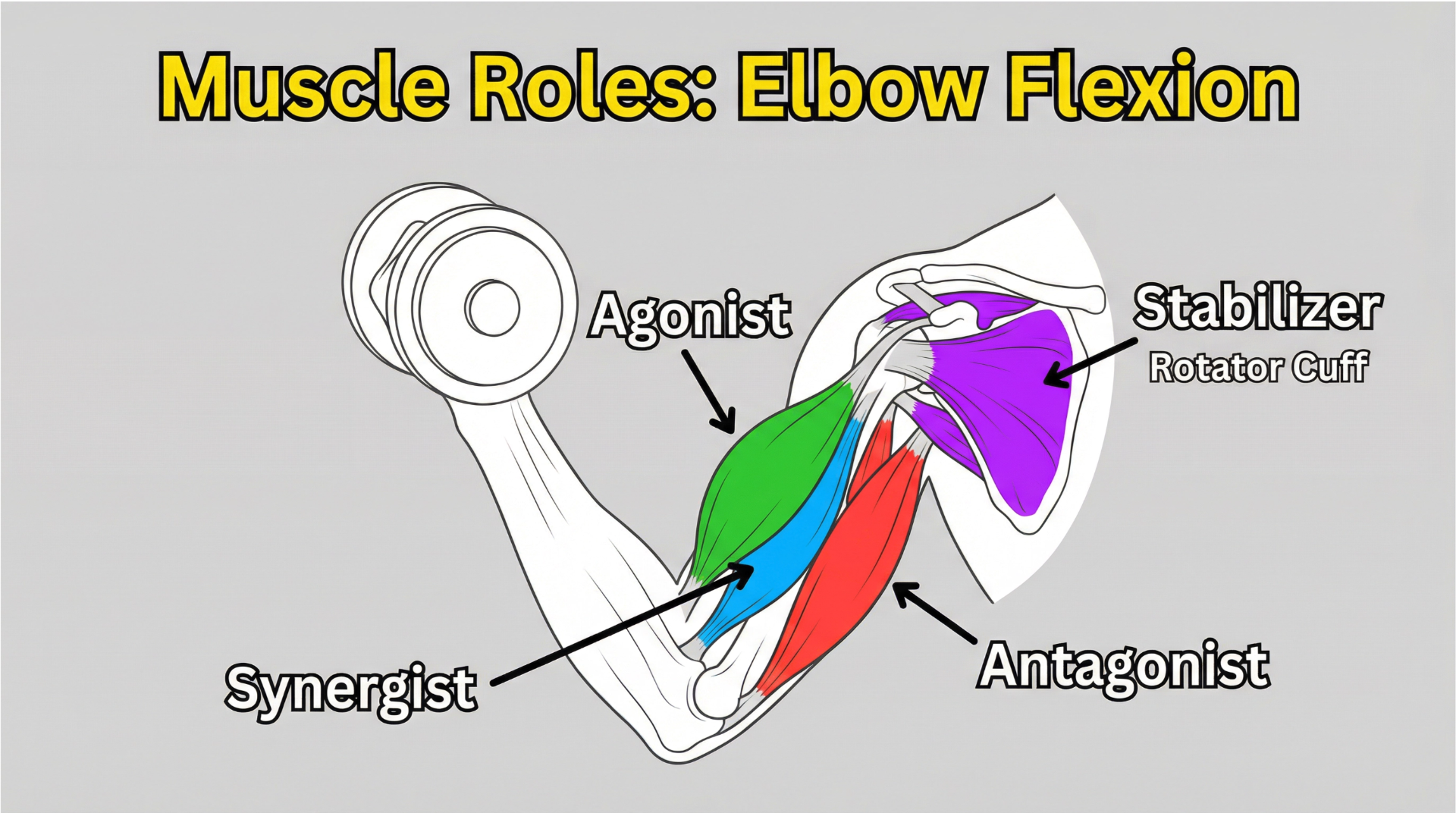
The Four Roles of Muscles
These roles are not fixed; a muscle might be an agonist in one movement and a synergist or antagonist in another. It all depends on the specific action being performed.
🟢 1. Agonist (Prime Mover)
The agonist is the muscle that provides the primary force to create a specific movement. It is the "prime mover."
Example: During a bicep curl (elbow flexion), the biceps brachii is the agonist.
🔴 2. Antagonist
The antagonist opposes the action of the agonist. It relaxes and lengthens to allow movement, and also decelerates movement at end range to prevent injury.
Example: In the bicep curl, the triceps brachii is the antagonist.
🔵 3. Synergist
Synergists assist the agonist by providing additional force or neutralizing unwanted secondary movements.
Example: The brachialis and brachioradialis assist the biceps in elbow flexion.
🟣 4. Stabilizer (Fixator)
Stabilizers contract to hold a bone or joint in a fixed position, providing a stable base for the agonist to pull from.
Example: The rotator cuff muscles stabilize the shoulder during a bicep curl.
Common Movement Examples
Knee Extension
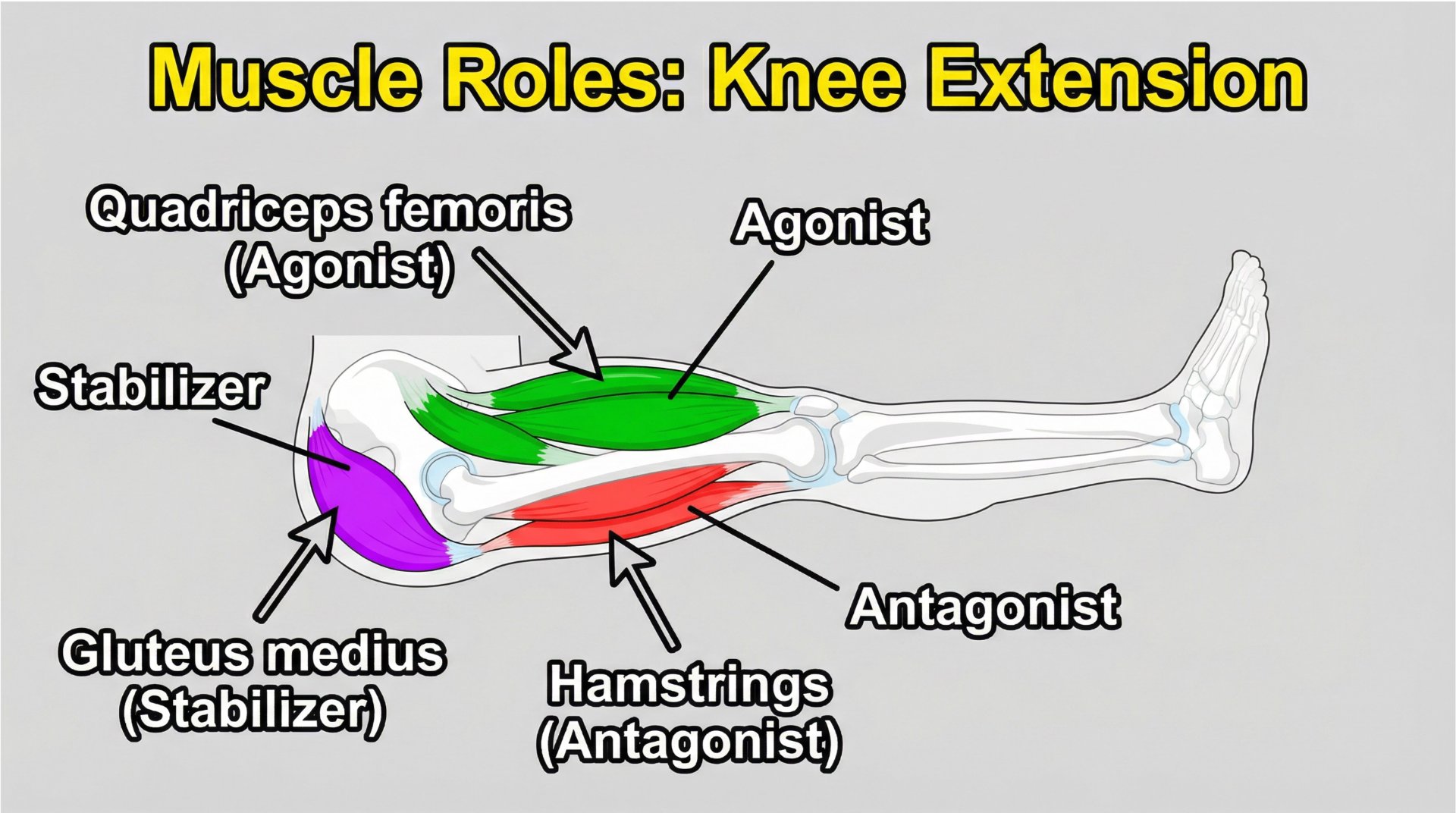
🟢 Agonist
Quadriceps femoris
🔴 Antagonist
Hamstrings
🔵 Synergist
Tensor fasciae latae
🟣 Stabilizer
Gluteus medius & minimus
Shoulder Abduction
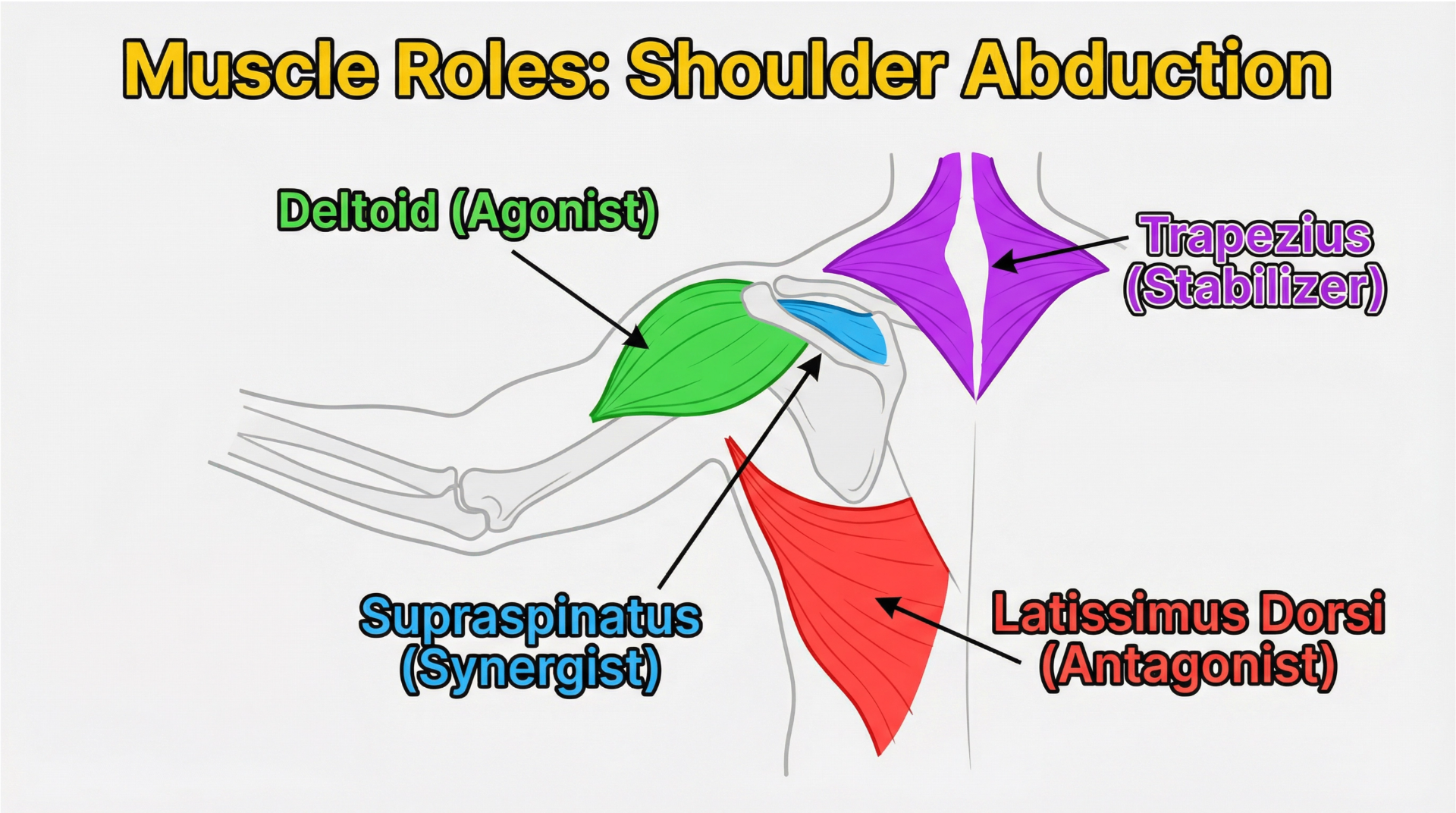
🟢 Agonist
Deltoid (middle fibers)
🔴 Antagonist
Latissimus dorsi & pectoralis major
🔵 Synergist
Supraspinatus
🟣 Stabilizer
Trapezius & serratus anterior
Clinical and Functional Importance
🏥 Physical Therapy
Therapists strengthen agonists, stretch tight antagonists, and improve coordination of synergists and stabilizers to restore proper movement.
🏆 Exercise Science
Trainers target specific muscle groups in their various roles to improve performance and prevent injury.
🏗️ Ergonomics
Understanding muscle cooperation helps design workspaces that reduce the risk of musculoskeletal disorders.
Summary
| Muscle Role | Function | Example (Bicep Curl) |
|---|---|---|
| 🟢 Agonist | Primary mover | Biceps brachii |
| 🔴 Antagonist | Opposes the agonist | Triceps brachii |
| 🔵 Synergist | Assists the agonist | Brachialis |
| 🟣 Stabilizer | Provides a stable base | Rotator cuff |
Movement is a team effort. The intricate interplay between agonists, antagonists, synergists, and stabilizers allows for the vast range of human motion, from the delicate touch of a fingertip to the powerful stride of a sprinter.
References
- OpenStax. (2013). Anatomy and Physiology. open.oregonstate.education
- Physio-pedia. Muscle Biomechanics. physio-pedia.com